GHK-Cu research: liver, skin, lung and hair
A tour of experiments that took this peptide far from its plasma origins, including a hair result whose lower-strength mixture did better.
Collagen synthesis in 1988
The Maquart and colleagues experiment used human fibroblasts in culture. Collagen synthesis began to increase between 10^-12 and 10^-11 M and reached its maximum at 10^-9 M. The cell count remained unchanged.
That last observation earns its place in the archive. A dish containing more cells might produce more collagen for an ordinary reason. Here, the authors found a change in collagen synthesis without a corresponding change in proliferation. These concentrations describe the culture medium only.
Few observations in this collection persuade me as readily. It still leaves the delivery and clinical questions for the skin studies.
GHK and hair growth
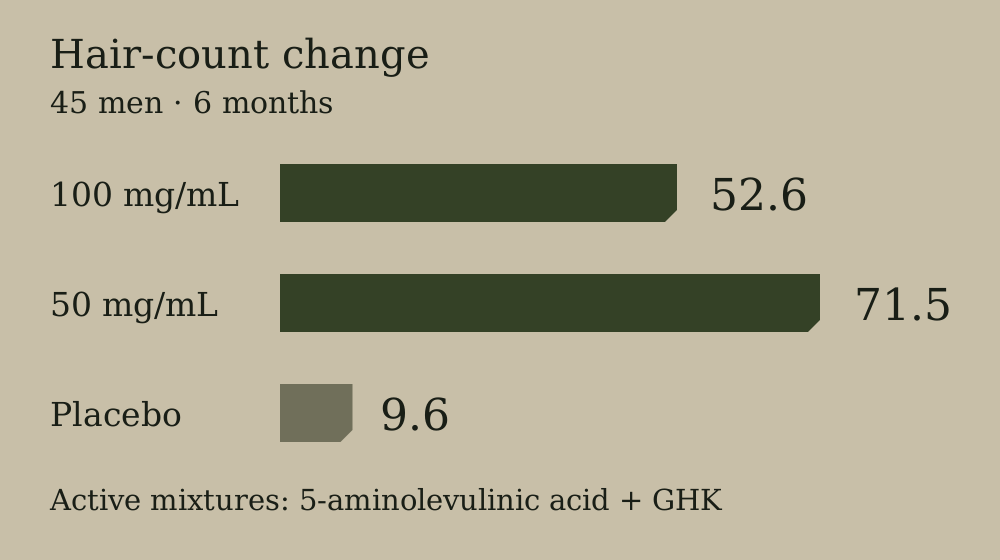
The controlled human hair study followed 45 men with androgenetic alopecia for 6 months. It tested a complex of 5-aminolevulinic acid and GHK. The reported hair-count increases were 52.6 with the 100 mg/mL mixture, 71.5 with the 50 mg/mL mixture and 9.6 with placebo. No adverse events were reported in any group.
The lower-strength mixture produced the larger gain. That reversal is the passage I underline: it resists a tidy more-is-better account, and the study did not establish why it happened. Neither ingredient was tested alone.
In GHK-Cu hair growth research, this trial supplies a human result for a particular combination. Pure GHK-Cu’s contribution remains unresolved. The trial also supplies no established timeline for pure GHK-Cu regrowth and no demonstration of DHT blockade; the broader follicle rationale concerns tissue support and blood-vessel growth.
Human lung cells
The Campbell study from 2012 began with an emphysema-related gene-expression signature and then tested GHK in lung fibroblasts from people with COPD. At 10 nM in culture, the cells recovered collagen-gel contraction toward the level seen in non-COPD cells. Integrin beta-1 expression and the cells’ internal structure also changed.
There is an ingenuity here that I admire: a database prediction is followed by a test of what cells actually did. Contracting a collagen gel gives the gene signature a functional companion. The work remained in cultured cells: breathing, symptoms and clinical recovery were outside the test.
Fibroblasts from old mice
In He and colleagues’ 2024 study, GHK changed the behavior of fibroblasts taken from aged mice. Migration and collagen-gel contraction improved; the senescence markers p21 and p53 fell, while p63 and PCNA increased. Senescence describes a persistent state in which cells have stopped dividing and behave differently.
The 2020 aging review also discusses reduced reactive oxygen species in stressed cells and improved spatial learning in aged mice treated with GHK. Those are separate experimental settings. This emphasis on movement and contraction adds to my interest: a simple collagen tally would miss those aspects of repair. A human anti-aging effect still requires human testing.
Wounds and behavior in rats
A collagen matrix incorporating biotinylated GHK accelerated dermal wound healing in rats. That result includes both a modified peptide and a biomaterial delivery system. The 2008 tissue-remodeling review brings together additional wound models involving collagen, blood-vessel growth and recruitment of repair cells.
The archive has less familiar branches too: anxiety-like behavior in rats and pain-induced aggressive-defensive behavior in rats changed in experiments with GHK or its analogs. Their animal setting and the particular peptide form stay attached to those findings. They supply possible leads for further animal experiments. I see little support here for expanding the skin claims.
Who else has reproduced the work?
Loren Pickart and collaborators account for a large share of the foundational papers and reviews. Replication of the wider gene-expression and anti-aging claims remains limited. The Campbell lung-cell work and the Ladiges-group aging literature add results from other teams, but they address particular questions rather than reproduce the entire thesis.
My confidence grows most when a second group tests the same material against the same outcome. Another favorable finding in a different model adds interest; a direct replication would add something else. The GHK-Cu references make the authorship and study settings easy to follow.