GHK-Cu collagen research and skin delivery
Collagen production is only the beginning of the skin question. The compound also has to arrive where the experiment needs it.
Collagen, elastin and skin texture
GHK-Cu’s skin reputation has a recognizable experimental base. The human fibroblast cultures produced more collagen, and the 2015 skin-regeneration review describes increased synthesis of elastin and other matrix components. The small topical studies reviewed there reported improvements in firmness, clarity, fine lines, wrinkle depth and skin density.
The controlled facial studies generally involved about 20–71 people. The topical findings justify further investigation, in my judgment. Their size leaves the likely magnitude of a visible change much less settled. The studies watched changes over weeks to months, with formulation and delivery among the variables.
The famous collagen percentages need their full description. The review reports increased collagen production in 70% of treated women, alongside figures of 50% for vitamin C and 40% for retinoic acid. The 70% describes the share of subjects with an increase, rather than a 70% increase in collagen.
Copper peptide vs retinol
Retinoic acid, the comparator named in the reviewed collagen findings, is a stronger relative of retinol. The figures were not established by a direct head-to-head trial of GHK-Cu and retinol. A winner cannot be assigned from that comparison.
A podium built from those percentages would be premature. The more interesting question is how a specific formulation changes skin over time, with a comparison designed to measure that change. The 2025 anti-wrinkle review returns repeatedly to the practical difficulty of delivery.
The CO2 laser study
In the 2006 trial after CO2 laser resurfacing, 13 patients received topical copper tripeptide complex or control treatment. The objective erythema outcome—redness—showed no statistically significant difference. Patient satisfaction was significantly higher in the GHK-Cu group, with p=0.04.
The separation between satisfaction and measured redness is unusually useful. This small trial gets a prominent place here because it prevents the skin story from becoming a procession of favorable results. People liked the treatment more, while the objective comparison supplied a null finding. Both observations survive together.
Human skin penetration in vitro
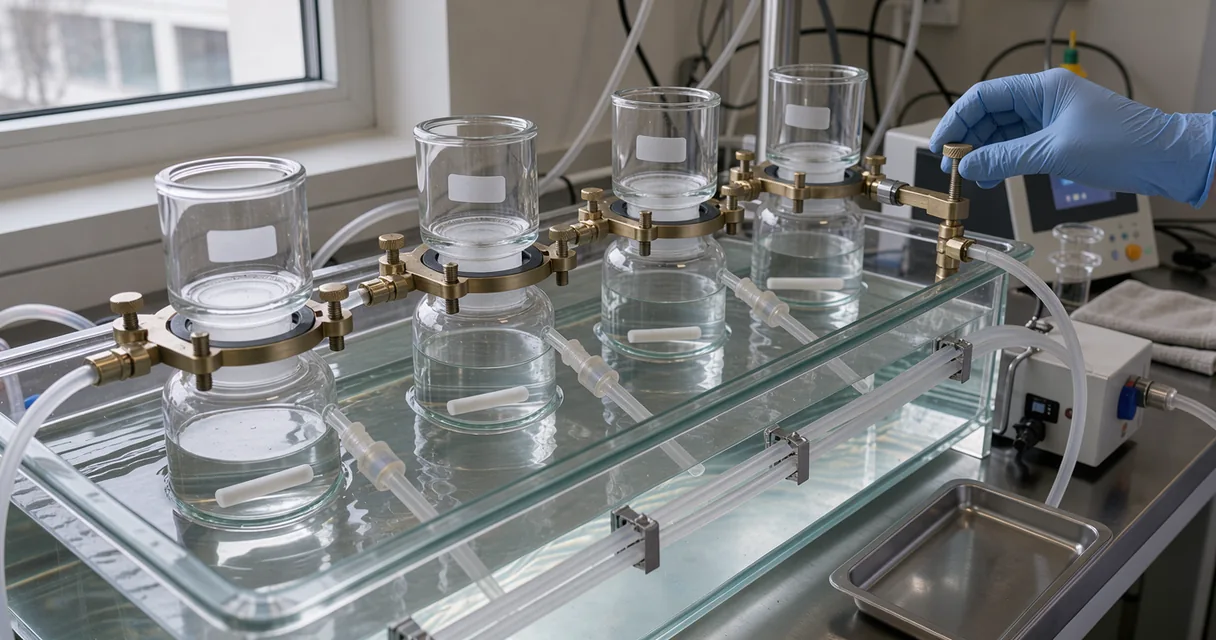
Hostynek, Dreher and Maibach studied copper penetration as a function of skin layer using human skin outside the body. In dermatomed skin, a preparation with some layers removed, the permeability coefficient was 2.43 ± 0.51 × 10^-4 cm/h. Over 48 hours, 136.2 ± 17.5 µg/cm² of copper permeated and 97 ± 6.6 µg/cm² was retained as a dermal depot.
The measured substance was copper applied as the tripeptide complex. Those quantities locate copper in that experimental setup; the study did not establish a cosmetic benefit or a human systemic dose. The skin preparation is essential to interpreting the result.
For a compound with such elaborate cell biology, the barrier is a wonderfully ordinary complication. A molecule can be active in a dish and still present a difficult formulation problem.
Carriers and formulation stability
The 2025 review describes free GHK’s poor passive skin penetration, with clogP -2.24, a measure reflecting its preference for water over fat. It discusses fatty modification, liposomes and microneedle pretreatment as delivery strategies. One reviewed experiment with fatty-modified GHK reported approximately 134 nmol permeating after microneedle pretreatment, versus none through intact skin. That is experimental delivery research, with no personal-use protocol implied.
A 2023 liposome study used carriers about 100 nm across. They remained stable for 4 weeks at room temperature and produced 48.9% elastase inhibition in human epidermal cells without cytotoxicity in that test. Elastase breaks down elastin. This is a cell result for a carrier system.
Acidity also matters. Strong reducing agents such as ascorbic acid and low-pH actives can disrupt the copper complex. The formulation literature makes stability part of the skin question, alongside irritation and other reported effects.